

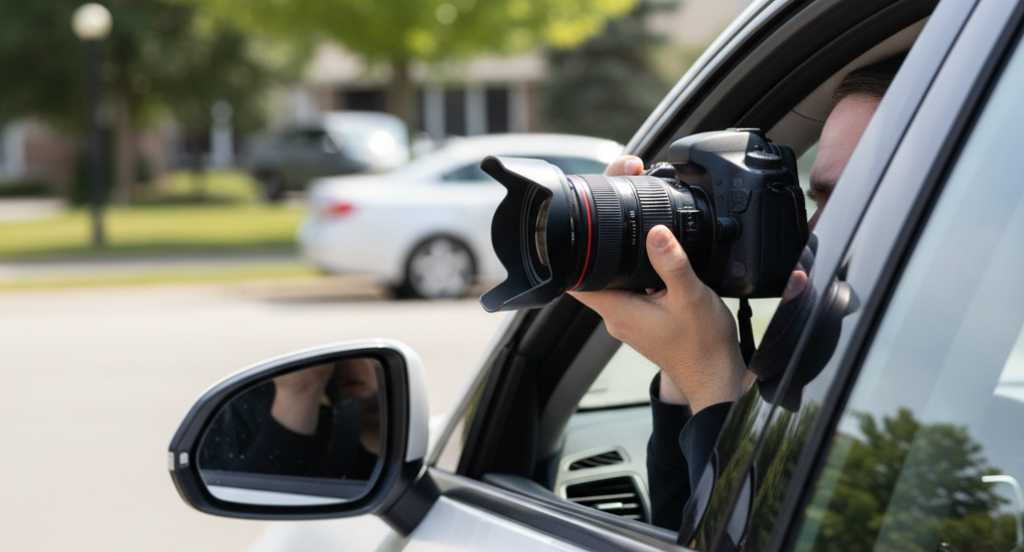
Here’s the first thing to know: there is no such thing as a surveillance license. No state issues one. What people mean when they ask about a surveillance license is whether they need a private investigator license to watch someone, and the answer is almost always yes, but not for the reason most people assume.
After 17+ years working cases nationwide, we’ve watched this question trip up good people repeatedly. The confusion is understandable, because the act of observing someone in public is not itself illegal. Anyone can sit on a public street and watch a house. So why would a surveillance license be required at all? Because the law isn’t regulating the watching. It’s regulating the service.
What the Surveillance License Question Is Really Asking
The line has nothing to do with cameras, distance, or technique. It’s this: are you gathering information for someone else, for compensation?
If you sit outside your own property watching your own car, no surveillance license question arises. You’re a person looking at a thing. The moment someone pays you to watch, or you do it on their behalf to report back, you’re providing investigative services, and in the states that regulate the profession that requires a private investigator license.
In our experience, that’s the sentence that resolves 90% of the confusion. The surveillance license question is never about the watching, it’s about selling the observation.
Why “Surveillance License” Is the Wrong Search
States don’t license surveillance as a standalone activity. They license investigation, and surveillance sits inside it. That’s why hunting for a surveillance license turns up nothing useful: you’re looking for a credential that doesn’t exist, when the one you need is a private investigator license from your state’s regulator.
Most states and the District of Columbia require some form of licensure or registration for investigators or investigative agencies. A small number have no statewide requirement, though local rules may still apply and neighboring states won’t recognize your work.
The Exemptions, and Why They’re Narrower Than They Look
Some states carve out exemptions, and this is where the surveillance license question gets genuinely subtle. Florida’s logic is the clearest illustration of how these actually work.
Florida exempts people holding another professional license when they’re providing services within that profession. So a licensed accountant can perform forensic accounting without a private investigator license. But not everything they might want to do falls under it. Surveillance isn’t an activity accountants normally perform, so an accountant who conducted surveillance would need a private investigator license anyway.
That’s the pattern across states with exemptions. The exemption covers the profession’s normal work, and surveillance is almost never inside that boundary. In our experience, people read “I’m exempt” and stop reading. The exemption is activity-scoped, not person-scoped.
Other commonly cited exemptions to check carefully in your own state:
- Employees investigating internal matters for their own employer, in some states
- Insurance adjusters handling claims within their licensed scope, in some states
- Investigators directly and exclusively employed by an attorney, in some states
- Claims and collections work, sometimes, sometimes not
Every one of those carries “in some states” for a reason. None of them is a national rule, and the exemption that exists next door may not exist where you are.
What Happens If You Skip It
This is not a paperwork violation. Under the Texas Private Security Act, conducting investigations without a Texas license is a Class A misdemeanor, a second conviction is a third-degree felony, and it’s also a Class A misdemeanor for anyone to knowingly hire an unlicensed investigator. Read that last part twice, because it means an unlicensed investigator isn’t just risking themselves. They’re exposing the client who hired them.
Several states also require licensed investigators to report known unlicensed activity or face sanctions against their own license. So the field polices itself, and it does so with real motivation.
The other cost is quieter and just as bad: evidence gathered without the surveillance license question properly answered can be challenged or excluded, and the case you worked for weeks stops counting.
A License Doesn’t Grant Special Powers
Worth saying plainly, because the surveillance license conversation creates a false impression. Licensed investigators operate under the same laws as everyone else. No special powers, no immunity.
What a license does is make it lawful to sell the service. It doesn’t let you:
- Trespass onto private property
- Wiretap or intercept communications
- Impersonate law enforcement
- Access private accounts or protected databases
- Place a GPS tracker where state law forbids it
- Record audio where consent law forbids it
Surveillance conducted from public spaces is generally lawful. If a passerby could see it, you can generally document it. Everything past that line is governed by trespass, recording consent, and privacy statutes that vary considerably by state and change more often than people expect.
Where Surveillance Work Actually Lives
Once the surveillance license question is settled, this is where the work is. On our team, surveillance runs through:
- Surveillance Investigations as a standalone service
- Infidelity Investigations
- Child Custody Investigations
- Criminal Defense Investigations
- Missing Person Investigations
- Asset Search and Asset Recovery
- Workers’ compensation and insurance claim work
- Corporate Investigations
In our experience, surveillance is also the fastest way to find out whether this profession suits you. It’s mostly patience, and the people who love it are rarely the ones who expected to.
Why the Rules Are the Point
Clients come to us during some of the hardest moments of their lives and hand us information that has to be handled with real care. Over 17+ years, we’ve learned that licensing isn’t red tape in this profession, it’s the difference between evidence and a liability.
A great investigator settles the surveillance license question before the first shift, not after a subpoena. They know what their state permits, they know where the line sits on recording and trespass, and they document facts objectively without ever needing to explain why they were there. The National Council of Investigation and Security Services tracks the regulatory landscape and is worth following.
We’ll Tell You Straight
We don’t expect anyone to have this memorized, and we’d rather answer the question than watch someone guess. Tell us what state you’re in and what you want to be doing, and we’ll tell you honestly what it requires. Sometimes the answer is that you’re closer than you thought. As our firm continues to grow nationwide, so do the opportunities for our investigators to advance, specialize, and build careers they’re proud of. We don’t just hire investigators, we help develop great ones. Read more about our team and how we work.
Ready to Do This Properly?
If surveillance is the part of this work that pulls at you, we’d love to hear from you. Whether you’re licensed already or you’re still sorting out what your state requires, that’s a conversation worth having before you invest in equipment.
Explore our current openings and see what it’s like to build a career here.
View Open Positions
Verify With the Source
- Texas Department of Public Safety, Private Security Bureau
- Florida Department of Agriculture and Consumer Services, Private Investigation Licenses
- California Bureau of Security and Investigative Services
Frequently Asked Questions
Is there such a thing as a surveillance license? No. No state issues one. Surveillance is regulated as part of private investigation, so what you need is a private investigator license from your state’s regulator.
Can I do surveillance without a license if I’m not charging? Careful. Some states regulate providing investigative services regardless of payment. Doing it for yourself is one thing, doing it on someone else’s behalf is where the surveillance license question bites, money or not.
Can I watch my own property without a license? Yes. Observing your own property, your own vehicle, or a public space as a private citizen isn’t investigative service and doesn’t require a license.
Does a license let me do things a regular person can’t? Barely. Licensed investigators have no special powers and no immunity. You still can’t trespass, wiretap, impersonate law enforcement, or record where consent law forbids it. What the license grants is the right to provide the service.
What if my employer asks me to look into something internally? Some states exempt employees investigating matters for their own employer, and some don’t. Check your state’s specific exemption before you start, because “my boss told me to” is not a defense.
How do I start a career with Terrance Private Investigator & Associates? Just reach out. Tell us about your background and what draws you to this work, and we’ll take it from there. You can view our current openings or contact us below.
Contact Us
Contact Terrance Private Investigator & Associates
At Terrance Private Investigator & Associates, we don’t just hire investigators, we help build great ones. If the surveillance license question is what’s standing between you and this work, we’d love to hear from you. Maybe you’re already licensed and looking for a firm that actually invests in your growth, or maybe you’re at the beginning trying to work out what your state requires before you commit. Either way, ongoing training, hands-on mentorship, and the chance to specialize are all part of building a career here, not just landing a job.
You deserve a straight answer about what this work requires before you spend money on it. Reach out today, tell us where you are, and let’s talk.
Email: getanswers@piterrance.com Website: piterrance.com Call or Text: (833) 495 0003